
PCNL & Mini-PCNL
Percutaneous Nephrolithotomy: The definitive keyhole surgery for large, complex kidney stones.
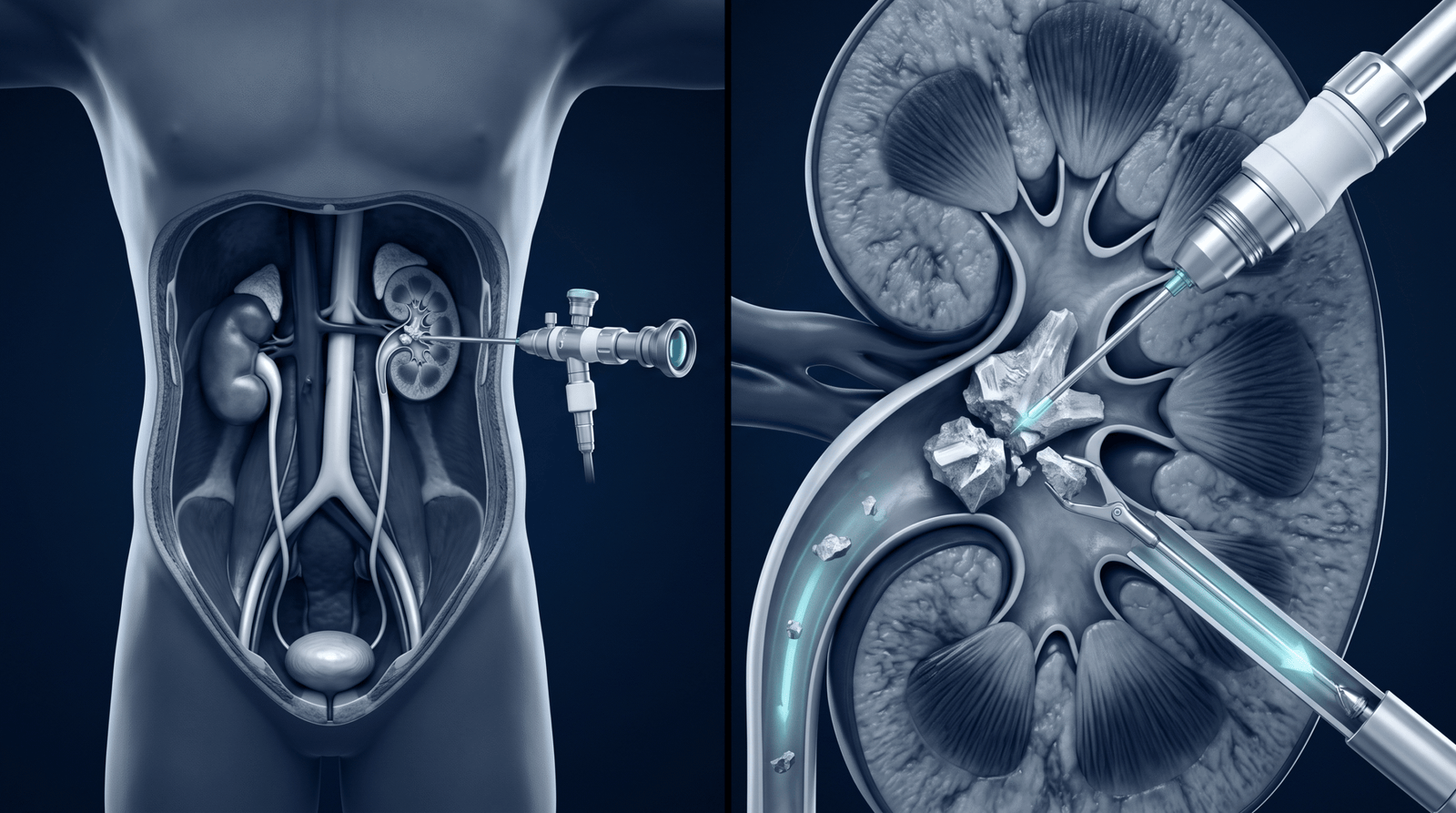
Tackling Large Stones
When a kidney stone grows too large (over 2cm) or forms a complex branching shape known as a 'staghorn calculus', lasers from below (RIRS) or shockwaves from outside (ESWL) are no longer efficient.
Percutaneous Nephrolithotomy (PCNL) is the gold standard for these massive stones. It involves creating a tiny keyhole tunnel directly through the back into the kidney to break up and vacuum out the stone fragments.
How The Procedure Works
1. Puncture
Under ultrasound or fluoroscopic guidance, a needle is precisely advanced through the flank into the kidney's collecting system.
2. Tract Dilation
The needle path is gently dilated to create a tract roughly the width of a pencil (or smaller in Mini-PCNL).
3. Fragmentation
A nephroscope is inserted, and powerful pneumatic or laser energy shatters the large stone.
4. Extraction
The large stone fragments are grasped and physically pulled out through the keyhole tract.
Why Choose Dr. Athar Hameed?
Dr. Athar Hameed specializes in 'Mini-PCNL', which uses miniaturized instruments to create a tract half the size of standard PCNL. This results in significantly less bleeding, lower risk of kidney damage, and a much faster recovery.
Frequently Asked Questions
Take the Next Step
Book a consultation with Dr. Athar Hameed today to discuss your symptoms and get a personalised treatment plan.